

Achieving Sustainable Public Transportation
with Autonomous Route Buses
A Worsening Shortage of Public Transportation Drivers
Amid nationwide trends of declining birthrates, a shrinking population, and an aging society, Japan’s public transportation sector is facing an increasingly severe shortage of drivers. Reductions in route bus services and the discontinuation of lines are particularly evident in regional areas, significantly affecting the daily life of residents and also local tourism. This trend is expected to accelerate with the aging of drivers, creating an urgent transportation issue across the country.
Many regions have recently introduced autonomous driving initiatives to sustain the operation of route buses, which continue to serve as an essential means of mobility in local communities. Expectations are high that the public availability of autonomous driving will open a key pathway to achieving sustainable regional transportation.
Autonomous Bus Demonstration
Addressing Regional Transportation Challenges through the Early Deployment of Autonomous Buses
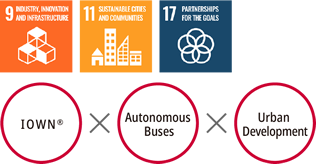
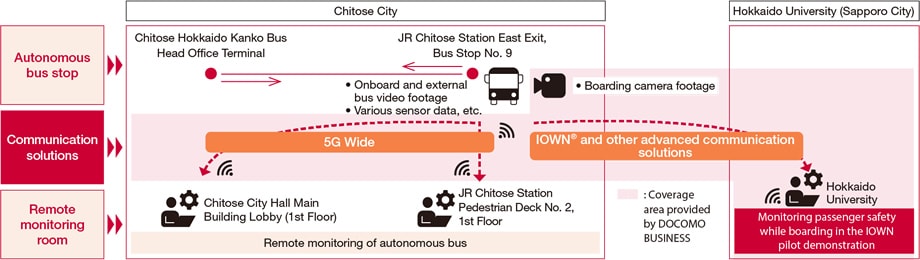
In November 2024, NTT DOCOMO BUSINESS partnered with Chitose City and multiple partner companies in a pilot demonstration of autonomous route buses in Chitose, Hokkaido. This pilot was part of HOKKAIDO IOWN® CAMPUS, a new collaborative effort involving companies, local governments, and academic institutions in Hokkaido for developing diverse industries and addressing regional challenges.
The demonstration tested Level 2 autonomous driving, in which the driver intervenes as necessary, on a route bus connecting the city center and a district with a high concentration of elderly residents while concurrently evaluating the effectiveness of remote monitoring. Video footage of passenger boarding and alighting as well as driving footage was transmitted to a remote control center using IOWN® APN*¹ and 5G Wide*². The demonstration examined passenger safety during boarding and alighting and the stability of video transmission under congested network conditions during commuting hours. Since video analysis increasingly relies on AI, highly precise, low-latency video transmission is essential for rapid remote response without onboard staff intervention to incidents such as passengers falling. The pilot confirmed the feasibility and effectiveness of low-latency, high-resolution, and stable video transmission, indicating progress toward Level 4—nearly fully autonomous driving. Subsequent demonstrations will build on these findings toward accelerating the deployment of autonomous driving to increase the convenience of public transportation in Chitose City and provide a solution to the nationwide shortage of drivers.
*1 A key technology of NTT’s IOWN initiative, a next-generation network and information-processing platform based on advanced optical technologies for high-capacity, low-latency transmission.
*2 Technology that ensures stable communication and higher speeds through packet-priority control even over congested networks.
Creating More Livable Cities through the Power of Mobility

-
Shunsuke Murakami
Smart Healthcare Taskforce,
Smart World BusinessGoing forward, we will further improve operational accuracy to enable immediate response to emergencies, while also addressing the challenges posed by heavy snowfall and cold climates. We hope the early deployment of autonomous buses will lead to making more cities sustainable and livable across Hokkaido.

-
Yuya Aikawa
Hokkaido Next-Generation Industry Promotion
& Urban Development Project Team,
Third Business SolutionsChitose City is expected to attract new residents as it develops into a hub for the semiconductor industry. We will work to ensure that autonomous buses and transportation DX open new possibilities for the city’s sustainable development and the growth of local industries.

-
Masaki. Hasegawa
General Manager Regional
Co-Creation Promotion Department,
Solution ConsultingOur goal in expanding these efforts to other regions and adapting them for on-demand mobility services is to lead municipalities and transportation operators into a future where people have choices based on the ability to travel and freedom of movement is a part of everyday life through the power of telecommunications and mobility.
Note: The content of this article is as of July 2025