

Addressing Dementia through
Simple Brain Health Checks
The Rising Prevalence of Dementia Due to an Aging Population
With Japan’s rapidly aging population, the number of people with dementia continues to rise. According to the Ministry of Health, Labour and Welfare, more than one in four older adults in Japan show symptoms related to cognitive impairment, including mild cognitive impairment, which is considered a precursor of dementia. This proportion is expected to grow further in the coming years. Dementia can present significant challenges in daily life for individuals and also place emotional and physical burdens on their families. It also places greater strain on public longterm care and medical budgets, making it a broader social issue. Because early detection is key to maintaining quality of life, more companies and local governments are offering screening programs for employees and residents. However, many are still struggling to design effective measures, while demand is rising for practical solutions.
Brain Health Check Steps
Extending Brain Health Span through Cognitive Function Checks
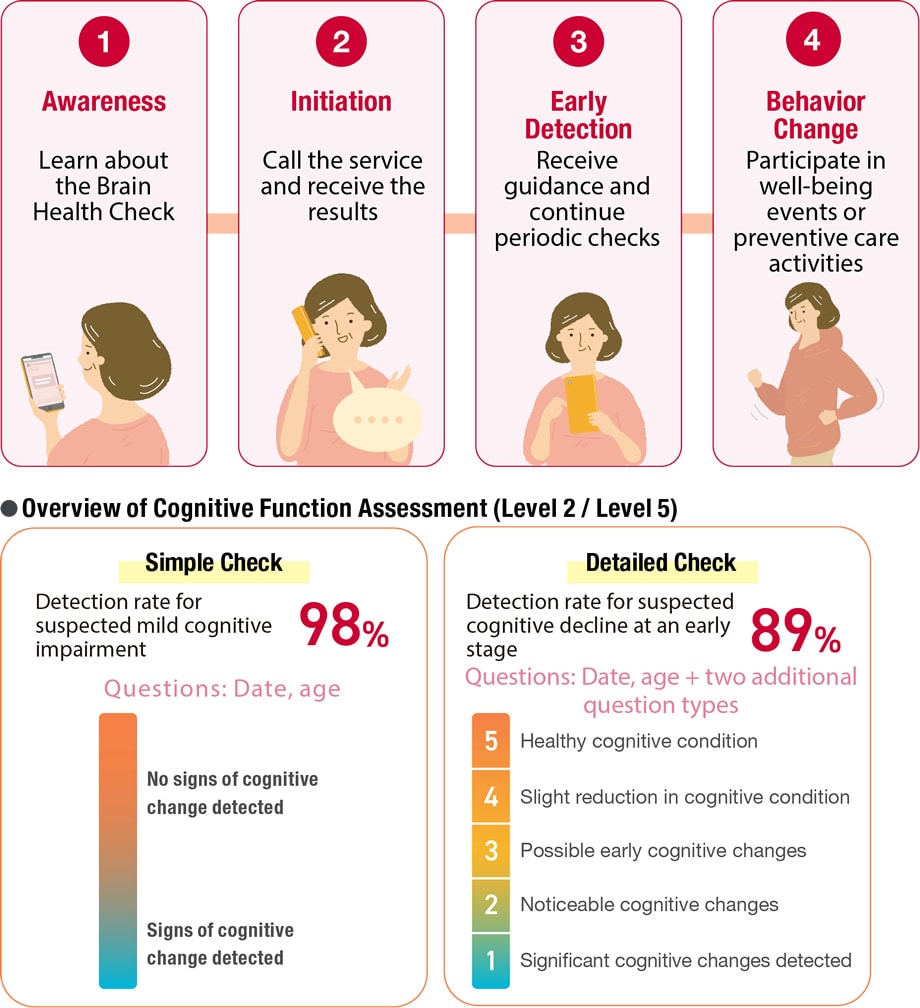
To help address social challenges associated with the increase in dementia, NTT DOCOMO BUSINESS is offering a service for local governments and corporations that checks brain health status over the phone and contributes to preventing dementia and maintaining cognitive function. This initiative is based on creating a society in which fewer individuals, families, and employers experience anxiety related to dementia. Developed in collaboration with Nippontect Systems Co., Ltd., a company that supports older adults and dementia care, the service was launched in April 2024 following two clinical trials that began in September 2022. The service uses the telephone as an interface that is easier for older adults to access. Users, including residents of contracting municipalities or customers of contracting companies, call a dedicated number and respond to automated guidance. From their responses, AI assesses potential cognitive decline using a two- or five-level scale, and the results are provided immediately. Requiring only about six minutes, the service has very little impact on the user and can be accessed from home. This eliminates the need to schedule or visit a specialized medical institution and allows users to participate without concerns about being observed by others. When signs of cognitive decline are detected, the system guides users toward recommended actions they can take, such as contacting consultation services, thereby facilitating behavior change and enabling early intervention.
Many local governments have been struggling with the growing burden of care-related costs and services. Companies managing customer assets or personal information, such as financial institutions, are also seeking ways to prevent issues that may arise when people are no longer able to handle personal affairs adequately. We are using this service as a starting point to extend healthy life expectancy and address the challenges associated with dementia.
Reducing Public Anxiety over Dementia

-
Yoshiko Takeuchi
Smart Healthcare Taskforce,
Smart World BusinessDementia symptoms are often difficult to recognize, which tends to delay responses. We are continually improving this service to make it easier to use and to establish it as part of a nationwide infrastructure that anyone can access. We want to help delay the onset of dementia and contribute to addressing social challenges such as shortening the period of required care and lowering medical expenses.

-
Kenta Miwata
Business Design Section,
First Business Solutions DepartmentWe are working with partner companies to establish a seamless support system, from the initial cognitive assessment to detailed examinations at medical institutions. Well-established follow-ups help ease concerns after the cognitive check and make it easier for users to take the first step. We want more people to feel less anxious about dementia and encourage everyone to maintain their brain health.
Note: The content of this article is as of July 2025