

Regional Revitalization through
Development and Provision of the
Land-Based Aquaculture ICT Platform
Urgent Need for Industrial Development in Depopulated Areas
Japan’s depopulated rural areas now account for roughly 60 percent of the country’s land area, and ongoing population decline is eroding regional vitality and increasing the risk of further contraction. Many of these areas have served as the backbone for Japan’s primary industries. In coastal regions, the aging of the fisheries workforce and acute labor shortages have become major challenges, contributing to the decline of a fish consumption culture and raising concerns about a decrease in national food self-sufficiency. One potential solution is land-based aquaculture. Although it requires more advanced technology than offshore aquaculture, land-based aquaculture provides easier control of the rearing environment and more stable production. It is increasingly viewed as a promising new business opportunity for regional revitalization, even for those without prior experience, since it does not require fishing rights and because ICT can lower the barriers to entry.
Value Proposition of the Land-Based Aquaculture ICT Platform
Opening Access to Land-Based Aquaculture
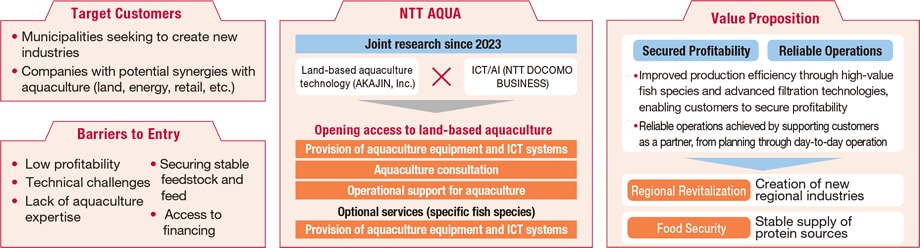
NTT DOCOMO BUSINESS developed the ICT Buoy, a device that visualizes sea conditions, to support areas affected by the Great East Japan Earthquake and has since been addressing challenges in fisheries across Japan. Subsequently, through joint research with AKAJIN, Inc., a company in Okinawa with advanced water-filtration technology, NTT DOCOMO BUSINESS established NTT AQUA Inc. in December 2024 as a Group company responsible for researching, developing, and providing circulating land-based aquaculture systems.
Opening access to land-based aquaculture as envisioned by the two companies provides the advantage of integrating the advanced water-filtration technology from AKAJIN Inc. with land-based aquaculture facilities and ICT/AI. Unlike conventional biological filtration tanks, this filtration method is easy to maintain, significantly improves production efficiency, and eliminates the need for biological filtration tanks. As a result, it offers excellent space efficiency and makes it possible to repurpose unused facilities such as closed school buildings or vacant properties. The role of NTT AQUA Inc. is to build the ICT platform that supports day-to-day operations in land-based aquaculture. The company has developed a dashboard, drawing from its experience with the ICT Buoy, that allows operators to monitor water quality and temperature and the status of aquaculture equipment through sensors. This facilitates the integrated management of collected data on the platform and pro-vides remote support to aquaculture operators in the event of abnormalities.
The company currently provides a fully integrated service spanning the provision of aquaculture equipment and ICT systems tailored for premium grouper species, as well as aquaculture consulting, remote operational support, and feed development and sales. Going forward, it intends to evolve its system for higher production efficiency by establishing an operational track record and applying AI analysis, thereby expanding the scope of land-based aquaculture.
Expanding Land-Based Aquaculture across Japan

-
Keiichi Yamamoto
President & CEO
NTT AQUA Inc.NTT AQUA’s mission is to work with local communities to share stories of regional revitalization through land-based aquaculture. We can play a role in local renewal and regeneration, even at the early stage of business development, by listening carefully to the real conditions and needs of each region. While our operations currently focus on a limited number of fish species, we expect to expand the range of species that we can handle as we gather data through our business activities for advanced AI analysis. Looking further ahead, we plan to collaborate with universities on research that repurposes wastewater from land-based aquaculture to support ecosystems and environmental conservation. Our goal is to offer solutions that increase the number of new entrants into land-based aquaculture across Japan and help ensure their business success, thereby enabling more communities to regain vitality through this new industry.
Note: The content of this article is as of July 2025