


November 9, 2026
NTT DOCOMO BUSINESS, Inc.
NTT DOCOMO BUSINESS Signs MOU with Four Companies for Collaboration toward Realization of Mega-Constellation Initiative
Accelerating efforts to realize range of satellite-based services and contribute to strengthening space infrastructure
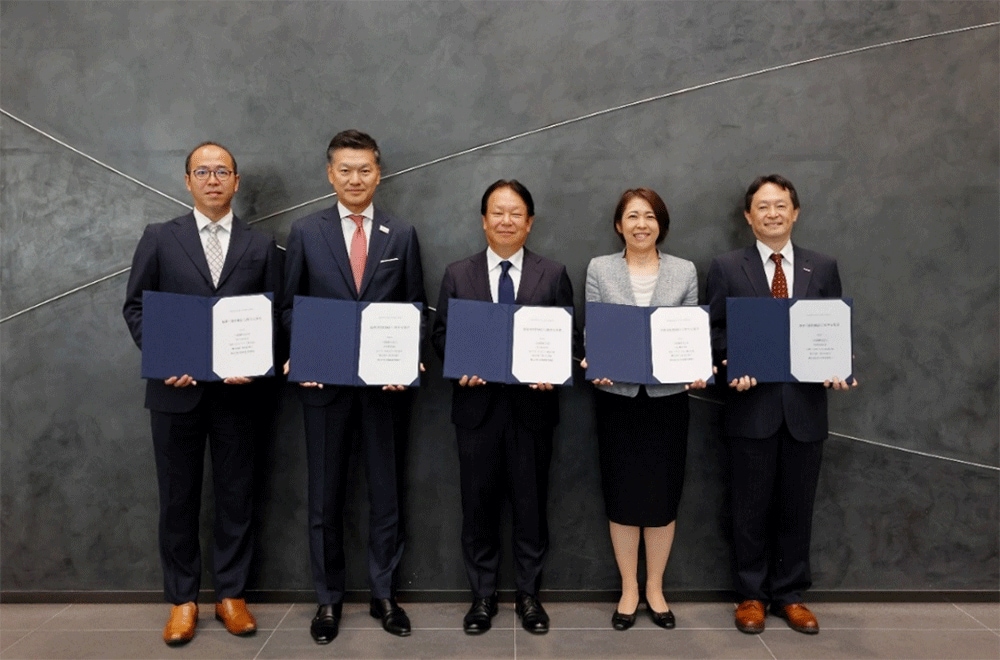
From left: Shumpei Tsuda, General Manager, Corporate Finance Department, Division 2, Development Bank of Japan, Yuichiro Moto, Managing Executive Officer, Group Head, Corporate Banking Group, MUFG Bank, Masahiko Arai, Executive Officer (Associate), Group President, Defense & Space Systems, Mitsubishi Electric, Minako Tsumenaga, Senior Vice President, Head of Alliance Division, Research and Development Marketing Headquarters, NTT, Kengo Nagase, Senior Executive Vice President, Representative Member of the Board, NTT DOCOMO BUSINESS
TOKYO, November 9, 2026 – NTT DOCOMO BUSINESS, Inc. announced today that the company has entered into a memorandum of understanding (MOU) on November 6, 2026 with Mitsubishi Electric Inc., NTT Inc., MUFG Bank, Ltd., and Development Bank of Japan Inc. to explore comprehensive collaboration on the development and operation of a mega-constellation—an integrated system in which numerous satellites operate in coordination to provide services covering broad areas of the Earth—and on the provision of services utilizing the constellation. Under the MOU, the five companies will examine the technical and business feasibility of commercializing a diverse range of services enabled by mega-constellations, including communications, Earth observation, positioning, navigation, and timing (PNT), and space data centers1.
In recent years, space development initiatives by both the public and private sectors have accelerated worldwide, driven by technological advances such as the miniaturization and enhanced capabilities of satellites, as well as increased launch frequency. In particular, satellite constellations, in which multiple satellites operate in coordination, are increasingly being utilized as social infrastructure in a wide range of fields, including communications, Earth observation, positioning, disaster prevention and mitigation, and national security. Against this backdrop, further efforts are needed to expand the use of space.
In response to these market circumstances, the five companies will combine their respective technologies, customer bases, financial capabilities, and business development expertise to pursue the realization of a sustainable and highly reliable mega-constellation business based on openness and interoperability. Additionally, they will work together to identify the required technological foundations and challenges, while examining and coordinating a concrete framework for collaboration.
NTT and NTT DOCOMO BUSINESS will leverage their expertise and technologies in providing telecommunications and ICT services to support the MOU’s envisioned technical studies on the overall system design and communications integration of the mega-constellation. Furthermore, based on customer needs, the two companies will examine optimal integrated coordination methods for inter-satellite, satellite-to-ground, and terrestrial communications. They will also explore the feasibility of systems that combine NTT’s R&D technologies, including its Innovative Optical and Wireless Network (IOWN®), with technologies and services of partner companies in Japan and overseas, as well as opportunities for collaboration and commercialization. As an “Industrial and Regional AX Platformer,” NTT DOCOMO BUSINESS addresses the business challenges of customers across a wide range of industries, including manufacturing, finance, logistics, and the public sector. Leveraging its expertise in building and operating networks, cloud environments, and AI infrastructure, the company is promoting the societal implementation of cutting-edge technologies to help customers utilize space and resolve issues in modern society.
Through this collaboration, NTT DOCOMO BUSINESS, Mitsubishi Electric, NTT, MUFG Bank, and Development Bank of Japan will accelerate studies aimed at realizing new services utilizing mega-constellations for customers in Japan and overseas. These studies will cover the development of communications and Earth observation infrastructure—including means of communication during disasters and in areas with limited connectivity—as well as the provision of positioning information and more efficient utilization of satellite data through the development of space data centers.
Through these initiatives, the five companies aim to strengthen space infrastructure and contribute to addressing a wide range of social issues.
Roles of Each Company in Exploring Commercialization
| Company | Role |
|---|---|
| Mitsubishi Electric | Conduct technical studies on the overall system design and integration of the mega-constellation, drawing on its expertise in satellite and ground system development. |
| NTT | Assess the feasibility of collaboration and explore future commercialization by leveraging expertise and technologies in inter-satellite communications, terrestrial communications networks, and communications services. |
| NTT DOCOMO BUSINESS | Explore to materialize the use cases and services corresponding to customer needs, by utilizing expertise cultivated through development and operation of communication network and provision of services to customers. |
| MUFG Bank | Support the development of businesses and manufacturing supply chains, as well as the expansion of sales channels, by leveraging its financial expertise and extensive customer base and network across a broad range of industries and business sizes in Japan and overseas. |
| Development Bank of Japan | Explore commercial feasibility from a neutral, long-term perspective by leveraging its financial expertise, as well as examining opportunities for collaboration with a broad range of stakeholders across industry, government, academia, and financial sectors. |
Minako Tsumenaga, Senior Vice President, Head of Alliance Division, Research and Development Marketing Headquarters, NTT Inc., said: “NTT aims to extend the communication and digital infrastructure we have cultivated on the ground into space, realizing a new social infrastructure that seamlessly integrates space and Earth. Taking this MOU as a catalyst, we will pool the technologies, business foundations, and expertise of our partners to create space infrastructure and new services originating from Japan. By leveraging our strengths in optical communication technologies, including IOWN, as well as terrestrial networks and digital infrastructure, NTT will work to realize a communication and data distribution platform that seamlessly links satellites and the ground. Through these efforts, we are committed to creating new value that supports people’s lives, industries, and overall safety and security.”
Kengo Nagase, Senior Executive Vice President, Representative Member of the Board, NTT DOCOMO BUSINESS, Inc., said: “In order to turn the vast amounts of data collected in space into value for industry and society, it is essential to ensure seamless coordination between the communications networks that deliver the data and the ICT infrastructure used to process and analyze the data. Leveraging the expertise we have developed through our IOWN® initiative and our AI-Centric ICT Platform® concept for a next-generation ICT platform optimized for the AI era, NTT DOCOMO BUSINESS looks forward to working with the other participating companies to explore commercial opportunities in areas including satellite communications and space-based data centers. By creating communications and data-utilization infrastructure that connect space and Earth, we hope to support AI adoption by enterprises for new business development.”
Yuichiro Moto, Managing Executive Officer, MUFG Bank, Ltd., said: “MUFG Bank views the space business as important social infrastructure with the potential to address a wide range of societal challenges. We have been working with stakeholders across industry, government, academia, and financial sectors to help build a new industrial ecosystem. Drawing on our experience using satellite data, our expertise as a financial institution, and our extensive customer base spanning a broad range of industries in Japan and overseas, we will contribute to building the space industry value chain and work to address diverse societal challenges.”
Tetsuji Ito, Managing Executive Officer, Development Bank of Japan Inc., said: “To date, we have supported the development of new industries by providing financing and investment to space-related companies in Japan and overseas in fields including aircraft, satellites, space data utilization, in-orbit services, and space exploration. We have also worked to create connections between the technologies of space-related companies and existing industries. Under this MOU, in addition to drawing on our expertise as a financial institution, we will assess the potential for commercialization from a neutral standpoint and with a long-term perspective. By fostering collaboration among a broad range of stakeholders, we will contribute to the realization of next-generation social infrastructure and the creation of new industries.”
Masahiko Arai, Executive Officer, Group President, Defense & Space Systems, Mitsubishi Electric Corporation, said: “We aim to make the diverse capabilities of satellites—including communications, Earth observation, PNT, and information processing—available as social infrastructure whenever needed, and to deliver services that support both people’s everyday lives and national security. The signing of this MOU marks an important first step by five companies with complementary strengths toward achieving that goal.
Drawing on the technologies and expertise we have cultivated in the development and operation of satellite and ground systems, Mitsubishi Electric will turn new possibilities for the use of space into services that benefit society.”
1 Satellites equipped with data processing, storage and communication functions. To address the challenge of growing data volumes resulting from recent advances in Earth observation satellite capabilities, space data centers process data in space and transmit only the results to Earth, enabling efficient data utilization.
2026-R136