Theme 02
2All-Photonics Network (APN)

Shigenari Suzuki
- Team Leader
- IOWN TaskForce
- Innovation Center
- APN service planning and APN technical verification
- Participation in open community activities
- ・Packet Transport Telecom Infra Project: Open Optical & Packet Transport
- ・IOWN Global Forum: Open APN Task Force
All-Photonics Network (APN) introduces photonic (optical) technologies throughout the network, from network infrastructure to end devices. This enables dramatically lower power consumption, high-quality and massive-capacity transmission, and ultra-low latency—capabilities that are difficult to achieve with conventional electronics-based technologies.
To further advance these capabilities, NTT DOCOMO BUSINESS is undertaking the following initiatives.
APN Testing and Evaluation
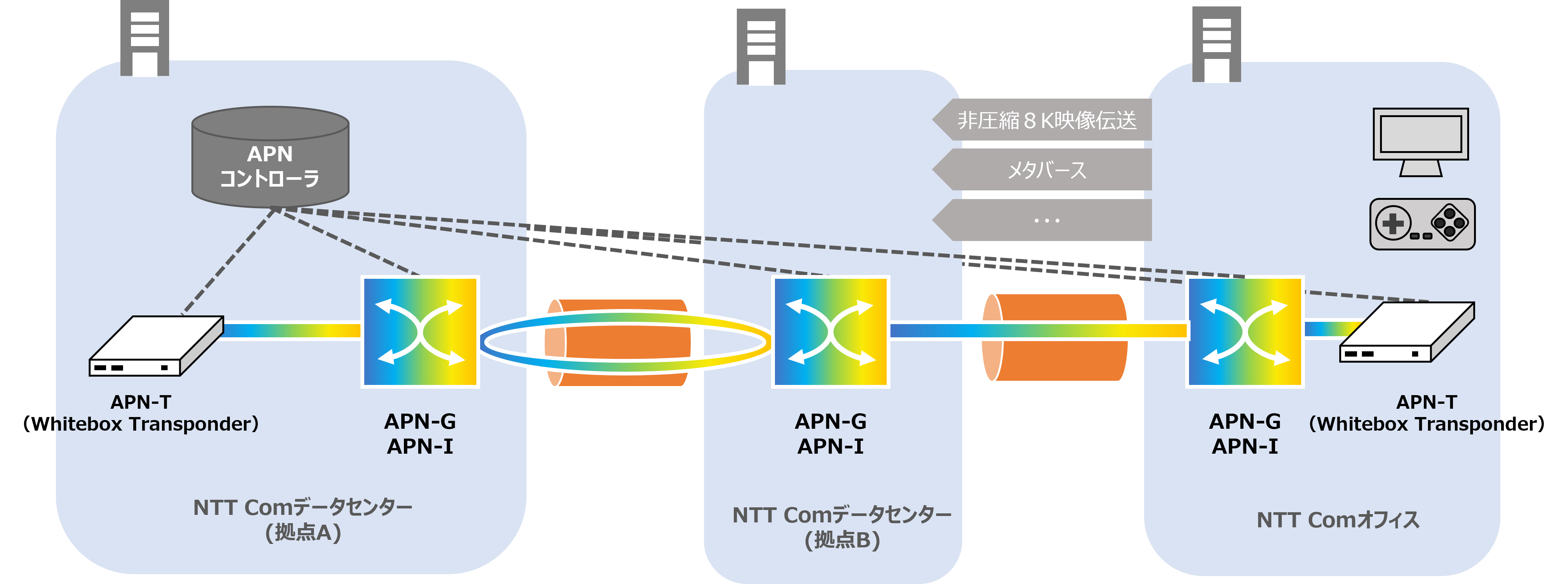
To advance APN technology development, environments for experimentation and validation are essential. For this purpose, NTT DOCOMO BUSINESS has built a field validation environment for APN by connecting multiple sites—including our offices and data centers—via optical fiber.
Working in collaboration with NTT Laboratories, we conduct use-case validations such as uncompressed 8K video transmission, metaverse applications, and haptic communication, as well as validation of software used to control APN (the APN Controller) and the Whitebox Transponder, which serves as a Flexible Bridge (APN-T).
We also validate APN operations. As part of this effort, we are evaluating Optical Network Digital Twin technologies, such as visualizing optical reachability before equipment deployment and dynamically reconfiguring the optical network according to equipment conditions after deployment.
Whitebox device technology development
Whitebox technologies enable open and flexible optical transport architectures for next-generation networks.
Whitebox devices are based on an architecture that allows hardware and the Network Operating System (NOS) to be freely combined. We consider them one of the key technology elements required to realize APN.
NTT DOCOMO BUSINESS participates in the Telecom Infra Project (TIP), an open community dedicated to advancing telecom infrastructure, and is advancing the development of Whitebox Transponders. In October 2023, our Whitebox Transponder became the first in the TIP community to receive the Silver Badge certification, indicating technical readiness. After internal deployment, in February 2025, we obtained Gold Badge certification, indicating that the product is ready for commercial use. We are continuing efforts such as badge certification for the latest generation of Whitebox Transponders.
Providing APN services
APN Leased Line Plan powered by IOWN® (APN Dedicated Line)—which delivers the low-latency and jitter-free communication quality that characterizes APN—was launched on March 1, 2024.
On January 29, 2025, the available interfaces were expanded. In addition, a 400 Gbps service option was introduced on July 1, 2025, further strengthening support for high-capacity connectivity.
Furthermore, starting October 1, 2025, the service began to be offered under the new brand name 'docomo business APN Plus powered by IOWN®' (hereafter 'docomo business APN Plus').
The name 'docomo business APN Plus' expresses the future expandability of the service by adding 'Plus' to "the APN Dedicated Line", which has already been widely used by many customers.
Through software-defined networking, the service enables flexible control of network bandwidth and routing. Looking ahead, we aim to expand its value further by leveraging Cognitive Foundation® to optimize resource utilization across multiple systems.
※Integrated into docomo business APN Plus
January 29, 2025: Expansion of the APN leased line plan powered by IOWN lineup | NTT DOCOMO BUSINESS (JP)
News September 18, 2025: Launch of docomo business APN Plus powered by IOWN®, a network service that supports the next-generation ICT platform optimized for the AI era | NTT DOCOMO BUSINESS Corporate Information (JP)
docomo business APN Plus NaaS Plan | NTT DOCOMO BUSINESS Corporate Customers (JP)
| Provisioning format | Bandwidth | Interface |
| Fixed bandwidth and pricing type | 10Gbps | 10GBASE-LR |
| OTU2 / OTU2e | ||
| 100Gbps | 100GBASE-LR4 | |
| OTU4 | ||
| 400Gbps | 400GBASE-FR4 / 400GBASE-LR4-10 | |
| Variable bandwidth and pricing type (NaaS Plan) | 100Mbps~10Gbps | 10GBASE-LR |
Moving forward, by further expanding the docomo business APN Plus lineup and enhancing its functions, we will realize software-controllable networks and more reasonable prices, flexibly addressing the needs of companies in the upcoming AI era for distribution, flexibility, security, and affordability. Through this, we will materialize the AI-Centric ICT platform Vision optimized for the AI era, while supporting an autonomous distributed society and aiming for industrial development and regional revitalization.